Sunday, June 3, 2018

Destination Moon (1950) — The Prelude to Mars


The Pal Family Christmas card for 1949 photographed on the set of Destination Moon.
(Courtesy Gail Morgan Hickman from his book The Films of George Pal, Barnes 1977.)

“It never ceases to amaze how the ripples begun by this wonderful Hungarian genius [George Pal] continue to influence so many in the motion picture industry.”
—Arnold Leibovit, film director, producer, screenwriter

“[T]he visual effects in Pal’s [Destination Moon] were art. They are aesthetically stunning ... they bear the imprint of gifted artists’ hands.... [T]he Luna rocket of Destination Moon still [has] the capacity to astonish.”
—Justin Humphreys in “A Cinema of Miracles: Remembering George Pal,” from the memorial program notes for the Academy of Motion Picture Arts and Sciences’ George Pal: Discovering the Fantastic—A Centennial Celebration, August 27, 2008

Enthusiasts.
 “Destination Moon is a film with considerable dignity and, in a quiet way, a genuine sense of wonder.”
—Peter Nicholls in The Encyclopedia of Science Fiction edited by John Clute and Peter Nicholls

Naysayers.
“Trivial in plot ... viewed today Destination Moon is less than impressive; the rocket journey is ploddingly consistent with the scientific standards of 1950...” —John Baxter in Science Fiction in the Cinema

Summary. Persuaded that the “other side” may get to the moon first and establish a military base to hold the world hostage, American industry (as opposed to any government agency) elects to build a rocket that will travel to the moon. In an evenly-paced, almost documentary fashion, we get to know the four men manning the rocket and experience with them the sensations of traveling in space and landing on the moon.


(courtesy Wade Williams Distribution)
Comments. The 1950 film Destination Moon ought not be misapprehended, maligned, or devalued, for the simple fact is that with no Destination Moon, few of the movies in this blog (and in the book of the same title from which this blog is derived; see cover on right), if any at all, would ever have come into existence. I’m a firm believer in prime sources and fate through connections.

It worked this way: Before Destination Moon, there were ridiculously few serious science fiction films worthy of the term. One would need to go as far back as 1929’s Frau in Mond (The Woman in the Moon), 1931’s Frankenstein, and 1936’s Things to Come to find any worthy antecedent (1930’s funfest Just Imagine and the Flash Gordon and other fantasy serials wouldn’t count as they simply danced to a different drummer).

A classic, poignant Puppetoon - 
Copyright © Arnold Leibovit
Enter George Pal, a Hungarian gentleman who made cute commercial-like ads that played as short subjects with movies in Europe, but later he advanced into animated cartoon-like shorts. Because he used carefully hand-manipulated tiny sculptures instead of drawings, his shorts were called “Puppetoons” and they became popular in Europe. Luckily, Pal was in the U.S. when Hitler invaded Poland. He was offered a contract to produce his Puppetoons for Paramount Pictures, and they soon joined the ranks of American animated shorts competing with the likes of Warner Bros.’ Looney Tunes, MGM’s Tom and Jerry, Universal’s Woody Woodpecker, and Disney’s whole menagerie.

By 1949, Pal was anxious to get into feature films. After much effort, he convinced independent Eagle-Lion pictures to co-finance a two-picture deal based on ideas he happened to be obsessed with at the time—as long as he paid half the costs. The first picture, The Great Rupert, about a Puppetoon-like dancing squirrel and starring then popular comic Jimmy Durante, flopped. But the second picture, Destination Moon, was a different story. The journey of its production and release is discussed below, but first I want to make clear how positively vital the film is. Here is the short version:

Eagle-Lion’s publicity department proved to be on top of its game when it saw the promotional possibilities of a picture about a rocket to the moon. They promoted the hell out of it in both general family magazines and the then rising star science fiction digest magazines, emphasizing its Technicolor and its cadre of class-A consultants. Destination Moon was constantly in the limelight of the popular press, including Life magazine, and soon its success seemed a forgone conclusion.

Enter Robert L. Lippert, a producer of very inexpensive, very quickly made films designed to veer droves of the unwary into theaters. He noticed all this nationwide publicity for Destination Moon and remembered that (1) longtime producer-director Kurt Neumann had not-too-long before offered him a script about a trip to Mars, which was populated with dinosaurs, and that (2) Jack Rabin, who owned a special visual effects company, had brought him an idea about a trip to the moon. Though Lippert was not interested in either pitch at the time, he changed his tune and he decided he’d be an idiot not to take advantage of all this free promotion for Destination Moon. While Destination Moon had been in production for two years and was costing more than half a million dollars, Lippert was able to combine Neumann’s and Rabin’s ideas to create a similar film, Rocketship X-M, with $94,000 and a shooting schedule of 18 days. In fact he made it so fast, it arrived in theaters a full month before Destination Moon.

Eagle-Lion Promotion at the top of its form!
For his 1995 volume, They Fought in the Creature Features, film scholar Tom Weaver interviewed Lloyd Bridges, one of the stars of Rocketship X-M, who said, “With Rocketship X-M we did beat our competitor, Destination Moon. And they paid a lot more for their production. We kind of took
advantage of the publicity they were putting out—people weren’t quite sure whether they were seeing that picture or our picture.”

Both films were huge popular and financial successes. (Rocketship X-M is also covered in this blog ss a sequel to this post; the productions of Destination Moon and Rocketship X-M are inevitably linked, and my two articles are intended to be read in sequence.)

The simple historical facts are these: If Destination Moon had not appeared to have been a slam-dunk, Lippert would never had bothered to make Rocketship X-M. If both pictures, released one right after the other, had not provided the one-two punch of major unexpected financial success, studio executives would never have awakened to the fact that there was a big market for films about outer space and rockets. But once producers saw the writing on the wall, before you knew it, throughout the very next year, in 1951, audiences were treated to The Day the Earth Stood Still, Flight to Mars, Lost Continent, The Man from Planet X, The Thing from Another World, and When Worlds Collide.

If Destination Moon had failed, George Pal’s career could well have died on the vine and he may have never made When Worlds Collide and The War of the Worlds (1953). If those two Paramount films had not succeeded, there would never have been Forbidden Planet or This Island Earth.

Just a tad slow getting started (not counting 1951’s Abbott and Costello Meets the Invisible Man) by 1953 Universal-International Pictures finally gets into the act, and soon we are fortunate enough to be graced with It Came from Outer Space and The Creature from the Black Lagoon. On and on, studio after studio, production company after production company, year after year, the science fiction boom of the 1950s and 60s was upon us—all kick started by George Pal and his Destination Moon.

During the dramatic conclusion of Destination Moon, the Luna could not take off until its weight was drastically reduced. The crew removed everything, whether it was bolted down or not (courtesy Wade Williams Distribution).

By 1952, as both audiences and executives were getting comfortable thinking “outside the box” and being happily diverted by overtly imaginative films (usually with special visual effects), then someone realized that it might be a good time to re-release RKO’s 1933 King Kong yet again (as pointed out by Bill Warren in his Keep Watching the Skies!). Bolstered by a heavy advertising campaign that included TV ads throughout the summer of 1952 (remember, this was when TV was still stalwartly making inroads into America’s living rooms), King Kong was a smash success, causing production companies (especially Warner Bros.) to realize that similar movies about giant monsters could also be successful. This ushered in countless giant creatures beginning with The Beast from 20,000 Fathoms. The immense success of Beast inspired Warner Bros. to produce the giant-ants-on-the-loose picture—Them!—which in turn spawned a decade’s worth of giant insect movies.

1952 re-release poster.
Indeed, the success of the King-Kong-inspired The Beast from 20,000 Fathoms had repercussions immense beyond anybody’s wildest fantasies. When Japan’s Toho Studios was left holding the bag when a co-Indonesian film deal fell through, Toho producer Tomoyuki Tanaka was desperate to fill the already scheduled and budgeted production time. He remembered the recent success of The Beast from 20,000 Fathoms and decided the giant monster scenario had relevance for the Japanese public, and thus was born Godzilla; but that is a whole ’nother story that is spelled out in awesomely minute detail in countless books, magazine articles, and websites (See Kalat, Ryfle, Brothers.)

The point that I’m making is that it is crystal clear that the production and success of Destination Moon was the stone thrown into the pond, initiating ripples upon ripples that have proven indelible and are stronger today than ever. I feel that this is important and should not be forgotten or taken for granted. I take issue with Warren who states in his Keep Watching the Skies: “It is ... easy to overrate Destination Moon ... the film is conventional, even a little dull” and also Gail Morgan Hickman, who writes in his The Films of George Pal, “By today’s standards perhaps there is little about Destination Moon to distinguish it.”
 
(courtesy Wade Williams Distribution)
In my view, Destination Moon was a fascinating vital movie in 1950 and it is a fascinating vital movie now. I am unable to disassociate myself from the movie and the repercussions stemming from it. The movie was, is, and will continue to be the landmark film that changed the landscape of the film culture forever. And, frankly, I cannot understand how others can so easily dismiss it. In fact, while researching my book, I gathered together dozens of science fiction movie overview books, and I was dismayed that too many of these writers and critics take exactly the same tone, for example:

“Destination Moon makes rather dull viewing nowadays.”
—John Brosnan in Movie Magic
.
“Destination Moon now seems tame.”
—John Stanley in Creature Features: The Science Fiction,
Fantasy and Horror Movie Guide
.
“[The] script seems colorless and wooden.”
—Phil Hardy in The Overlook Film Encyclopedia: Science Fiction
.
“Destination Moon has aged badly ... [it] seems old hat and pedestrian to today’s viewers.”
—Barry Atkinson in Atomic Age Cinema

To my ear, these remarks seem no more than the half-baked attempts of the writers to appease modern readers by appearing “relevant” and “cutting-edge” and to gain their favor by casually dismissing anything that smacks of being “old-fashioned.” Yes, some of these commentators—but not nearly all—once having offered their aesthetic dismissal, perform an about face and try to put the picture into historical perspective, for example, Atkinson goes on to say, “But make no mistake about it, this picture, flaws and all, is a very important step in the evolution of the serious, special effects-laden science fiction motion picture that reached its peak with ... 2001: A Space Odyssey.”

Why castigate and dismiss the film, making super clear why it is a failed film, only to turn right around to declare the film "an important step in the evolution."?  It seems to me that a picture of Destination Moon’s importance does not deserve the many negative judgments that are ascribed to it so commonly today, judgments that can’t help but impact up-and-coming audiences. And the respect that is accorded it, too often seems begrudging.


Some of this criticism stems from the fact that all creative parties involved with Destination Moon wanted it to be as realistic and as scientifically sound as possible. As a result, the film has a documentary feel—which for some reason is anathema to many modern commentators who look back on the film. The film was designed to make people think. Clearly it met that goal far more than anybody could have imagined in 1950. How the picture plays in relation to newer movies is utterly irrelevant. The newer movies might not exist if it had not been for Destination Moon. Period.

One oft-repeated story that would seem to belie this striving for realism is the fact that the Lunar surface in the movie is crisscrossed with gaping cracks. Naturally this would imply that the surface was once mud, which requires water, and the moon doesn’t have any water. Noted artist and Hollywood matte painter Chesley Bonestell, who painted the large backdrop that mimicked Lunar crags and mounts, was unhappy with the cracks, which were designed by art director Ernst Fegté. “That was a mistake,” he insisted to Hickman. 

Note the improbable cracks (courtesy Wade Williams Distribution).

But Pal explained to Hickman, “Chesley was right, of course ... but we were shooting on a small soundstage because of our limited budget. We had to make the set look bigger. Chesley designed a beautiful backdrop, but it needed something to give it depth. That’s why we made the cracks. The cracks in the foreground were big and those in the distance were small, so it gave a real feeling of perspective. For some scenes we even used midgets in small spacesuits to add to the feeling of depth.” (Many readers will recall that the final airport scene in Casablanca also employed little people working around a cardboard cutout airplane in the foggy distance in order to give that dramatic scene perspective.)

Destination Moon was groundbreaking in countless ways. Thus, I feel a further word should be shared to explain how the film came to be. First off, a movie about a rocket to the moon was an idea whose time had come. In the late 1940s the idea seems to have sprung into the minds of a number of movie people at the same time. Some of the names (but not nearly all) associated with the birth (but not necessarily the completion) of Destination Moon are William Castle; Chesley Bonestell; Hermann Oberth, who had been the technical consultant for 1929’s Frau in Mond (The Woman in the Moon); Irving Block; Jack Rabin; Robert A. Heinlein; Willy Ley, Lou Schor; Alford van Ronkel; Peter Rathvon; Robert L. Lippert; Kurt Neumann; and George Pal. Block has said that his and Jack Rabin’s version never got made “because there was so much haggling.” It appears that at first William Castle, Rabin and Block, Kurt Neumann, and Robert Heinlein all independently tried to launch rocket-to-the-moon films, and it’s possible that, during their first attempts to garner outside interest, none were aware of the others. In the end, it was Heinlein, Van Ronkel, and Pal who made Destination Moon, while at the same time Rabin, Block, and Neumann made Rocketship X-M—both films beginning as more or less the same idea.

From concept in Jim Barnes’ aircraft factory, through building, to finally ready for takeoff (courtesy Wade Williams Distribution).

All that said, I’m fascinated by the similarities between Destination Moon and 1947’s The Beginning or the End with Brian Donlevy. The first is a docudrama about persuading American private industry to pool their resources to build a rocket to the moon before the “other side” can. The second and earlier film is a docudrama about persuading American private industry to pool their resources to build an atomic bomb before the Germans can. Yes, while the American industry angle is central to co-script writer’s Robert A. Heinlein’s novella “The Man Who Bought the Moon,” I’m pretty certain that the realities of the Manhattan Project, or some reflection of it as shown in the Donlevy movie, influenced the making of Destination Moon.

Once audiences were in theaters and anticipations high, Destination Moon began with a fabulous title sequence, perhaps not as dramatic as in some of Pal’s later movies, but perfectly appropriate. Against a starry background we see in the center of the screen a large moon, a Chesley Bonestell painting, accompanied by genius Leith Stevens’ eerie score, which easily set the mood for the entire movie. In fact, according to Hickman, “Stevens ... consulted with numerous scientists, including Wernher von Braun, to get an idea of what space was like in order to create it musically.” Taking this a step further, Cy Schneider tells us in his liner notes from the 1960 Destination Moon soundtrack Omega label stereo album:

Destination Moon soundtrack CD
"When Leith Stevens was called upon back in 1950 to compose a score for George Pal’s motion picture Destination Moon, he had a peculiar creative problem on his hands. The picture dealt with man making a rocket to fly him to the moon and this science fiction fantasy itself was created to play upon unexperienced emotions by showing images never before seen. At that time information on space, the moon’s surface, rocket launchings and all the other scientific lingo that has become popular knowledge today, was considerably harder to come by. It took Stevens over three months to steep himself in enough scientific lore to prepare himself to write the first notes. He consulted with many scientists.... In these conferences and by studying countless artist’s sketches of the moon’s surface, Stevens was able to discover what the space world was like. The result was a startling, particularly dramatic score which became immediately popular. The music evoked new feelings, new mental pictures ... it investigated a musical world never before probed or propounded so sharply."

The opening titles scroll up the screen much as we are used to from all the Star Wars films (which in itself was borrowed from the 1939 Buck Rogers serial). The final frames of the movie treat us with a declaration that would have been new and bold and exciting for audiences of the day: “The End ... of the Beginning.”
 
Of special note, this film includes a charming and delightful cameo appearance by Walter Lantz’ Woody Woodpecker. Because the whole idea of rockets and rocketry had not yet become household concepts in 1950, as George Pal explains in The Films of George Pal by Gail Morgan Hickman, “We wanted to explain what rocketry was in an amusing way.” In the scene where a roomful of potential corporate sponsors are gathered to hear Jim Barnes’ sales pitch about sending a rocket to the moon, he shows a colorful short Woody Woodpecker cartoon that helps seal the deal.
 
 
The Woody Woodpecker scene from Destination Moon
(courtesy Wade Williams Distribution)

 The only science fiction movies I can think of that could be considered of equal importance in terms of influence are Stanley Kubrick’s2001: A Space Odyssey and George Lucas’ Star Wars. Destination Moon has been part of The Wade Williams Films Collection for many years. In 2000, Wade Williams, Image Entertainment, and Corinth Films released a wonderful DVD with great color that is still widely available.
 
July 1950. Eagle-Lion Classics Inc., George Pal Productions, Inc. Technicolor. 1.37:1. 92m. Production Cost: $586,000. USA Gross: $5,000,000.
CREDITS: Director Irving Pichel. Producer George Pal. Screenplay James O’Hanlon, Robert A. Heinlein, Rip Van Ronkel; Inspired by Rocketship Galileo by Robert A. Heinlein. Score Leith Stevens. Orchestration David Torbet. Director of Photography Lionel Lindon. Production Designer Ernst Fegté. Editor Duke Goldstone. Production Supervisor Martin Eisenberg. Technical Advisor of Astronomical Art Chesley Bonestell. Sound William Lynch. Special Effects Lee Zavitz. Cartoon Sequences Walter Lantz. Technicolor Color Consultant Robert Brower. Technical Advisor Robert A. Heinlein.
CAST: Jim Barnes John Archer. Dr. Charles Cargraves Warner Anderson. General Thayer Tom Powers. Joe Sweeney Dick Wesson. Emily Cargraves Erin O’Brien-Moore.


Formal Notice: All images, quotations, and video/audio clips used in this blog and in its individual posts are used either with permissions from the copyright holders or through exercise of the doctrine of Fair Use as described in U.S. copyright law, or are in the public domain. If any true copyright holder (whether person[s] or organization) wishes an image or quotation or clip to be removed from this blog and/or its individual posts, please send a note with a clear request and explanation to eely84232@mypacks.net and your request will be gladly complied with as quickly as practical.

https://mcfarlandbooks.com/product/mars-in-the-movies/


Tuesday, April 24, 2018

War of the Worlds: Goliath (2012)


A one-sheet poster.
"It’s like all colorful and fun holidays rolled into one!"

I love this movie. War of the Worlds: Goliath is a positively delightful and startlingly clever animated film. Incredibly skillfully done and rendered perfectly in 3D, it’s like all colorful and fun holidays rolled into one. It calls itself a steampunk adventure, and that is perfectly true. In every way the animation is up for the job. The 3D pops. The titles are wonderful, with sepia-tone images showing different eras—both terrestrial and Martian—appearing and dissolving, all to the lovely strains of  “Forever Autumn” in homage to Jeff Wayne’s Musical Version of The War of the Worlds.

In fact War of the Worlds: Goliath is a perfect movie, making it one of the four Mars movies that are, in my view, perfect, in the same league as George Pal's The War of the Worlds (1953), Nigel Kneal's Five Million Years to Earth (UK title: Quatermass and the Pit), and The History Channel-Canada's The Great Martian War: 1913-1917.

Correction: Before I get into the story, I need to make this very important correction. In my book on page 192, I say, "If it wasn’t for the lame IRS subplot (thankfully brief), this would be a perfect movie."   This is in reference to a subplot about an Irish member of the team pictured in the poster above who has a brother with only one aspiration—to kill Englishmen, despite the Martians pounding and destroying all in their path. Initially I was troubled by this because I couldn't envision the IRA's priorities not shifting away from killing the English the very instant the Martians' heat rays started horribly disintegrating everything and everybody, clearly threatening our entire planet. However, due to a chance remark by my wife, and the resultant research, I've learned that during our real First World War (as opposed to the version that was about to break out in the movie and that was side-tracked by the Martian attack), when Germans were in fact mowing down English and French alike by the millions–quite literally—with their advanced machine guns and poison gas, the Irish Volunteers (from which the IRA later grew) took advantage of the distraction to kill and bomb and terrorize the English, creating a second front within the British Isles. My published remark was unfortunate because, had I realized that in this case that facts belie common sense, in my eyes this would have been then as it is now a perfect, completely satisfying movie on every possible level. Bravo, Mr. Pearson!  That said, here are some high-points of the story:
 
The conceit:  In 1898–99, as everyone knows, the Martians attacked earth and were defeated, and, of course, all their machines and other technology were left behind, which terrestrial engineers reverse engineered to remake the Earth’s future. However, there is always the fear that the Martians will return. In that event, earth’s nations have built an army of tripod war machines and huge zeppelins—A.R.E.S. (Allied Resistance Earth Squadron). Yet despite this universal dread, the nations of Europe are politically boiling over and World War I is about to begin. The A.R.E.S. international army is in the process of disbanding so that its individual soldiers can return to fight for their home nations.
 
The face of a Martian war machine.

But just then, the Martians do in fact arrive with super-souped-up war machines, A.R.E.S. stays together, and the machines royally battle it out. The earth’s greatest war machine, the Goliath, is put to the test. Fortunately, on the side of A.R.E.S. are Secretary of War Theodore Roosevelt, Professor Nikola Tesla, and a diverse crew of hero soldiers.

Check out the War of the Worlds: Goliath official site where you can download the digital film at http://www.wotw-goliath.com/

You know my opinion; now here are a couple of other perspectives (that are extracted from my book Mars in the Movies: A History by Thomas Kent Miller).

Enthusiast.
“From an animation and production standpoint, War of the Worlds: Goliath is a treasure trove, and very clearly a labor of love for the creators ... amazing, with the style best described as anime-inspired dieselpunk.”

A glimpse of a Martian war machine.
 
Naysayer.
“[J]ust a few cereal commercials shy of a pointlessly cartoon marathon—violent, messily drawn and lifelessly dragging.”
—Martin Tsai in the Los Angeles Times  

Martin  Tsai saw the same movie that Sean Korsgaard (just above) and I saw; how is it possible that Mr. Tsai could not recognize a true labor of love? How is it that he could actually go out of his way to diminish someone else's hard creative work?  I just don't get it.

War of the Worlds: Goliath (2012)
Malaysia, Japan, USA. Anderson Digital. Tripod Entertainment, Finas, MSC, Mavcap, Barking Cow Media Group. Animated. C. 1.77:1. 85m.
CREW: Director Joe Pearson. Script David Abramowitz. Story Joe Pearson. Producers David Abramowitz, Mike Bloemendal, Joe Pearson, Leon Tan. Executive Producer Kevin Eastman. Score Luka Kuncevic. Animation Director Young Hwan Sang. Editor Toby Risk.
CAST: Adrian Paul, Adam Baldwin, Mark Sheppard, Peter Wingfield, Elizabeth Gracen, Jim Byrnes, Beau Billingslea, Joey D’Auria, Kim Buckingham.


Formal Notice: All images, quotations, and video/audio clips used in this blog and in its individual posts are used either with permissions from the copyright holders or through exercise of the doctrine of Fair Use as described in U.S. copyright law, or are in the public domain. If any true copyright holder (whether person[s] or organization) wishes an image or quotation or clip to be removed from this blog and/or its individual posts, please send a note with a clear request and explanation to eely84232@mypacks.net and your request will be gladly complied with as quickly as practical.

http://www.mcfarlandbooks.com/book-2.php?id=978-0-7864-9914-4

Saturday, March 31, 2018

Flash Gordon’s Trip to Mars (Mars Attacks the World) (1938)


Top: From this serial, one of many iconic spaceships in the Flash Gordon series.
Bottom: Title card for this serial.
Special photo juxtapositions by Thomas Kent Miller; copyright © 2016-2017 by Thomas Kent Miller.

It’s entirely possible that some, perhaps many, readers of my book and/or this blog may not have ever seen a serial, or, for that matter, may have no idea what the word “serial” means. While researching my book, I’ve met a number of “twenty-somethings” who have just relished the new Star Wars: The Force Awakens film (released December 18, 2015) but who drew a blank when I mention that the film is the seventh chapter in George Lucas’ homage to Flash Gordon and Buck Rogers serials. For that matter, neither of those proper names rang any bells either. Therefore, a brief recap of serials is in order before I discuss the films themselves.

One-sheet poster.
In a simpler time, during a period from the mid–1910s to the early 1950s, some movie studios believed that they could entice moviegoers into the theater each and every week—regardless of what feature film was playing—by getting them so wrapped up in multi-chapter stories, with each 15- or 20-minute chapter ending in a suspenseful “cliffhanger,” that they would happily pay to see what happens next. This ploy worked so well that hundreds of action-adventure serials were produced: westerns, science fiction, super heroes, secret agents, jungle adventures, and lurid mysteries, among other genres. It was only the episodic shows on that newly invented medium television that killed the serials.


Cover of Kinnard, Crnkovih, Vitone book.
Flash Gordon’s Trip to Mars (1938), with 15 chapters, was the middle of three Flash Gordon serials, the first called merely Flash Gordon (1936) comprising 13 chapters and the third called Flash Gordon Conquers the Universe (1940) with 12 chapters.

In their volume The Flash Gordon Serials: 1936–1940, Roy Kinnard, Tony Crnkovich, and R.J. Viton explain the allure of Flash Gordon and the success of serials:

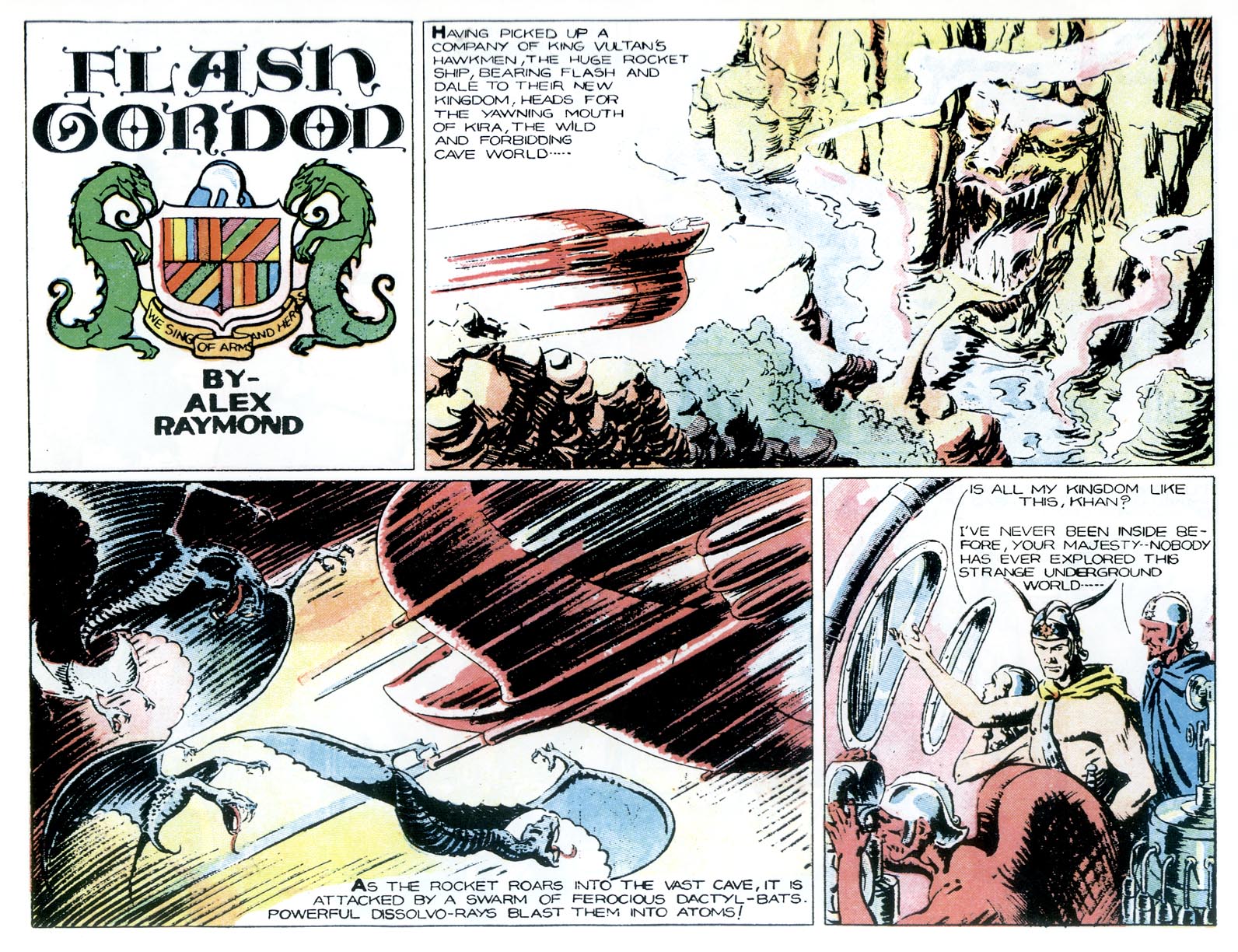
“Artist/writer Alex Raymond’s newspaper comic strip Flash Gordon debuted on January 7, 1934, and was an immediate hit with a Depression-era public sorely in need of escapist adventure. Conceived by Raymond and the Hearst newspaper chain as competition for the already established rival strip Buck Rogers, Flash Gordon soon eclipsed Buck in popularity...."

Example of original Alex Raymond's Flash Gordon comic strip, which debuted in newspapers in 1934.

.
"... In 1935 Universal Pictures—the studio that had startled the world in 1931 with Dracula and Frankenstein—acquired the film rights to several newspaper comic strips published by King Features Syndicate, including properties like Secret Agent X-9, Ace Drummond, Jungle Jim, and Flash Gordon, correctly speculating that the established popularity of the strip characters would virtually guarantee the success of any serial based on them.... [Today] the theatrical movie serial is a long defunct neglected screen format almost forgotten.... Yet these old serials, three of them in particular— the trilogy of Flash Gordon serials starring Buster Crabb—have had a continuing influence on modern films, especially the work of George Lucas in his Star Wars series.”


Universal Pictures was adept with elegant matte paintings. Most of the top of this wonderful establishing shot is a painting.
.
The “cliffhanger” was a gimmick that annoyed as much as it pleased. Each serial chapter would end with the hero in a terrible situation that could only end in his death—for example, a building blowing up with the hero still inside—and the next week’s chapter would quickly summarize in words or drawings the previous week’s story and then show a recap of that bad business, but this time including a shot or two that had been conveniently left out the previous week, shots showing how easily the problem was resolved, allowing our hero to live for another day. In the above example with the exploding building, the start of the next episode would include a brief shot showing the hero dodging debris as he ran out of the building just as it exploded.

But how could such a thing influence Star Wars? In point of fact, George Lucas grew up during the 1950s when the Flash Gordon serials were often shown on television, usually Saturday mornings. These shows captured the imaginations of the ten-year-olds who watched them, positively enthralling them because the shows were so wildly fantastic, making all too real all sorts of odd beings in armor and helmets and wielding strange weapons, and the whole effect was mesmerizing. When the time came for George Lucas to follow up his super-successful American Graffiti, he decided he wanted to pay tribute to those entertaining serials—that featured real good guys and real bad guys—and that enchanted him as a child. 


Top: Crawl from Star Wars: A New Hope.
Middle: From Buck Rogers.
Bottom: From Flash Gordon Conquers the Universe..
 
Lucas envisioned 1977’s Star Wars as the fourth chapter in a hypothetical serial and began it with the yellow scroll (often used in serials) that summarized the hypothetical (but then nonexistent) third chapter and then dropped viewers right into the middle of the action. 

In 1977, there were many in his audiences who shared that same thrill of watching serials when they were younger and who understood the serial references. But that was forty years ago. While the thrill of seeing a new chapter in a continuing series still is very, very much alive (for that is precisely what Star Wars is and has done with each of its succeeding seven chapters to date, with more to come), the cinematic awareness of historical serials has faded. As stated above, “The theatrical movie serial is a long defunct neglected screen format almost forgotten....”

.
.


Emperor Ming Charles Middleton.
Believing they have watched Ming the Merciless die in a fire on his planet Mongo (which had been on a collision course with earth in the previous 13-chapter serial called simply Flash Gordon), Flash Gordon, Dale Arden and Dr. Zarkov are glad to have gotten home safely in a rocketship and to be feted by a relieved world populous for their troubles. 


Source of mysterious ray on Mars.
But a mysterious ray aimed at earth from space is creating earthquakes and huge storms. It’s nearly certain that the earth will be destroyed if something isn’t done, but all the brightest scientists have no idea about the ray, have no idea of what is happening, let alone how to stop it—all except Dr. Zarkov, of course, who has photographed the otherwise invisible ray, which he believes is coming from Mongo. Knowing they are Earth’s only hope, Flash, Dale, and Zarkov get back in their rocketship to return to Mongo. 


From top center, clockwise: “Happy” Hapgood
Donald Kerr. Flash Gordon Larry (Buster)
Crabbe. Dr. Zarkov Frank Shannon. Dale Arden
Jean Rogers.
But they have company; an enterprising reporter named “Happy” Hapgood has stowed away and is surprised he’s on his way to Mongo. But, before they leave the solar system, Zarkov realizes the beam is not coming from Mongo, but from our own planet Mars.


Queen Azura Beatrice Roberts.
They change course, crash land, and are pursued by soldiers loyal to Queen Azura, Queen of Magic, ruler of Mars. They escape into a cave only to be astonished by the presence of the Clay People, creatures who were once men but punished for various indiscretions and turned into mud by Azura’s magic.

Clay King Montague Shaw.
It seems that Azura has been at this for quite a long time, because the Clay People have not only established their own kingdom ruled by the Clay King, but they have been waging war on the queen, much to her dissatisfaction. Which begs the question: why would Queen Asura continue to punish her people, turning them into clay, thereby adding to the Clay People population that’s waging war on her? Be that as it may, Queen Azura has the perfect means to defeat them. All she needs to do is suck all the nitrogen out of the earth’s atmosphere to make the ammunition for her army’s ray guns. That is the source of the beam that is wreaking havoc with the earth’s land masses and climate. Before long, our heroes are amazed to discover that Ming the Merciless had escaped the fire on Mongo and has come to Mars to join forces with Azura ... 

All three serials are available in boxed sets.
.... and that is only the first two chapters titled “New Worlds to Conquer” and “The Living Dead.” The remaining thirteen have titles that shed light on the arc of the whole story: “3-Queen of Magic,” “4-Ancient Enemies,” “5-The Boomerang,” “6-Tree- Men of Mars,” “7-The Prisoner of Mongo,” “8-The Black Sapphire of Kalu,” “9-Symbol of Death,” “10-Incense of Forgetfulness,” “11-Human Bait,” “12-Ming the Merciless,” “13- The Miracle of Magic,” “14-A Beast at Bay,” “15-An Eye for an Eye.” In the end, we discover that Ming is planning to take control of Mars and he succeeds in killing Azura. Before she dies, she tells Flash how to change the Clay People back into men. Ming’s plan to control Mars has been thwarted and he loses his mind, bent on destroying the earth. Flash saves the day, Ming dies, and our heroes return to earth, glad to be home and feted for their troubles.

***

The special visual effect of the Clay People emerging from and returning into their cave walls is stunning and still shocking. However, the serial’s spaceship special effects were never especially good, but they have the benefit of inspiring nostalgia.

The dialog is, more often than not, stunningly infantile and redundant and incompetently presented. Yet this serial’s costumes and set design are often quite marvelous. In other words, Flash Gordon’s Trip to Mars is a mixed bag, but that can easily be said of the entire Flash Gordon series and, if truth be told, the whole serial format.

Nevertheless, I adore all three Flash Gordon serials, not so much for reasons of quality but more due to the nostalgia and pleasant memories that are inseparable from the shows themselves. Besides, it is all too true that the Star Wars series is little more than Flash Gordon writ large—very large.

One-sheet for Mars Attacks the World.
Once the serial had run its course, Universal recut the 300-minute serial down to a 68-minute theatrical feature named Mars Attacks the World.

Flash Gordon’s Trip to Mars (Mars Attacks the World) (1938)
USA. Universal Pictures. BW. 15 Chapters. 1.37:1. 300m.
CREW: Directors Ford Beebe, Robert Hill. Script and Original Story Ray Trampe, Norman S. Hall, Wyndham Gittens, Herbert Dalmas. Based on The Newspaper Feature Entitled “Flash Gordon” owned and copyrighted by King Features Syndicate. Comic Strip by Alex Raymond. Associate Producer Barney A. Sarecky. Director of Photography Jerome Ash. Art Director Ralph DeLacy. Editors Joe Gluck, Saul A. Goodkind, Louis Sackin, Alvin Todd. Costume Designer M. Berneman.
CAST: Flash Gordon Larry (Buster) Crabbe. Dale Arden Jean Rogers. Dr. Zarkov Frank Shannon. Emperor Ming Charles Middleton. Queen Azura Beatrice Roberts. “Happy” Hapgood Donald Kerr. Prince Barin Richard Alexander. Clay King Montague Shaw.

Formal Notice: All images, quotations, and video/audio clips used in this blog and in its individual posts are used either with permissions from the copyright holders or through exercise of the doctrine of Fair Use as described in U.S. copyright law, or are in the public domain. If any true copyright holder (whether person[s] or organization) wishes an image or quotation or clip to be removed from this blog and/or its individual posts, please send a note with a clear request and explanation to eely84232@mypacks.net and your request will be gladly complied with as quickly as practical.

Monday, February 12, 2018

21 Posters and Pix That Would Have Been Nice in Mars in the Movies

My Book Mars in the Movies: A History is a ship that has sailed. Still. I can daydream. This is my third list of coulda/woulda/shoulda’s for graphics that I would have liked to have included in the book, but it was not practical.

1.  Twelve years after its initial release in 1953, The War of the Worlds was re-released. This is its principal re-release one-sheet. I like this poster.


2 & 3.  Visual effects expert Robert Skotak, says, “Some theaters in L.A. and New York projected The War of the Worlds at 1.85:1 with the proper 1.85:1 mask. The ads in newspapers featured the words ‘in widescreen’ [or ‘in panoramic screen’].” This was during the era of CinemaScope and the like. Top: A print newspaper ad for the original engagement of The War of the Worlds at the Mayfair theater in Times Square, New York City. Bottom: The Mayfair theater itself wrapped up like a Christmas present!  They don’t do movie promotions like they used to!
 .

Special photo juxtapositions by Thomas Kent Miller; copyright © 2016-2017 by Thomas Kent Miller.

4. 5. 6. & 7.  In the groundbreaking 1950 film Destination Moon, there is a scene early on showing a roomful of potential corporate sponsors gathered to hear a sales pitch as to why they should bankroll sending a rocket to the moon. Jim Barnes, who’s betting his reputation on the expedition, shows a colorful short Woody Woodpecker cartoon that helps seal the deal. I am venturing an intelligent guess that Chuck Jones’ space-based Marvin the Martian sprung from the space-based antics of the charming and delightful cameo appearance by Walter Lantz’ Woody Woodpecker in the film. Some things that tend to back up my supposition are the uncanny (or perhaps not so uncanny if my thesis holds water) resemblances between the two animated films. The story arc of the moon-bound rocket within each cartoon; the manner in which the rockets are first “revealed”; the look/design of the two rockets; the appearance of the two rockets in flight through space, and so forth (all illustrated by the two rocket screen-grabs below from the two shorts. For a detailed expansion on this theory, see my book Mars in the Movies: A History or my blog Mars in the Movies: A History … Now with Endless Possibilities and specifically the blog post about the 1948 introduction of Marvin the Martian in the short Haredevil Hare:
https://marsinthemoviesinteractive.blogspot.com/2017/08/haredevil-hare-1948-and-marvin-martian.html

Special photo juxtapositions by Thomas Kent Miller; copyright © 2016-2017 by Thomas Kent Miller.

8 & 9. Speaking of Marvin the Martian, he was given the honor of being the official NASA launch patch for Spirit, one of the two hugely successful Mars Exploration Rovers that landed on the Red Planet in 2004. How cool is that?

         Mars Exploration Rover (NASA)
Special photo juxtapositions by Thomas Kent Miller; copyright © 2016-2017 by Thomas Kent Miller.

10.  Walt Disney's John Carter of Mars, as Andrew Stanton’s film was called early on, would have had some nice poster art—with a special graphic logo designed for branding purposes that would have been plastered far and wide if the film had been given a chance, but the $250,000,000 movie was deliberately flushed down the toilet by the executives of its own company, according to Michael D. Sellers in his comprehensive John Carter and the Gods of Hollywood (Universal Media, 2012). Further, Disney had second thoughts about including “Mars” in the title because it had recently released a succession of movies with “Mars” in the title, none of which were especially successful, with one, Mars Needs Moms, being amongst the biggest money losers of all time, Thus, the movie was titled John Carter.


11.  Science-fiction novelist and Star Trek veteran David Gerrold’s path intersected with the life of a bright little boy whose existence within the foster care system left something to be desired, so much so that the boy began to believe that he was a Martian, requiring umbrellas, sun glasses, and all sorts of other aids to survive on this harsh planet earth. Gerrold decided that he must adopt the child, which he succeeded in doing, overcoming many challenges. He wrote a book about the experience titled Martian Child and it became a bio-movie with John Cusack (as Gerrold) and Amanda Peet.  I would have liked to have written about the movie for my book, but since it didn’t include the planet Mars in any active way … I just plain ran out of time when my deadline loomed. I’ll include my thoughts on this most pleasant film at some point in my blog Mars in the Movies: A History … Now with Endless Possibilities.


12. & 13. Nebo Zovot (The Heavens Call) was a wonderful 1959 science fiction movie made in the then-Soviet Union. Apparently one point of its existence was to prove to the West that the USSR could make a movie every bit as good as the best of Hollywood’s output. Ironically, after the B-movie king-pin Roger Corman bought it and handed it over to the novice filmmaker Francis Ford Coppola with instructions to turn it into a movie for American teenagers, Coppola’s version, Battle Beyond the Sun (1963), did not hold a candle to the original. Left: an original Soviet one-sheet. Right: The German 2009 re-release poster. I find these simple but intense and colorful posters a delight. In fact, as I was writing the book, I used the Soviet poster on the left as my mock-up cover, it so touches on or reflects my hopes for my book.

Special photo juxtapositions by Thomas Kent Miller; copyright © 2016-2017 by Thomas Kent Miller.

14. Flash Gordon’s Trip to Mars (1938), with 15 chapters, was the middle of three Flash Gordon serials made in the 1930s. Once the serial had run its course, Universal Pictures recut the 300-minute serial down to a 68-minute theatrical feature named Mars Attacks the World. While the poster below for the serial (left) did appear in the book, I would have liked to have included the poster for the cut-down version as well. No time like the present!

Special photo juxtapositions by Thomas Kent Miller; copyright © 2016-2017 by Thomas Kent Miller.

15 & 16. The Purple Monster Strikes (D–Day on Mars) (1945), with 15 Chapters, was the first Mars-related serial to appear after Flash Gordon’s Trip to Mars (1938). In the beginning, we watch a tiny smear of light crossing the screen, the first words intoned are, “Out of the infinite distances beyond the stratosphere, a strange weird object is hurtling through interstellar space towards the earth.” That’s all well and good, but the object is a one-man spaceship from Mars, hardly from “infinite distances” or “interstellar space.” So, right off the bat we know that hyperbole and nonsense science rule this story. Once the serial had run its course, Republic Pictures recut the nearly 3 1⁄2-hour serial down to a 100-minute feature named D–Day on Mars.

Special photo juxtapositions by Thomas Kent Miller; 
copyright © 2016-2017 by Thomas Kent Miller

17 & 18.  Flying Disc Man from Mars (Missile Monsters) (1950), with 12 Chapters, came close to being a remake of The Purple Monster Strikes. Made five years after The Purple Monster Strikes, the opening sequences of Flying Disc Man from Mars are virtually identical with the same stock-shot one-man Mars craft crashing into a field with the same stock-shot Martian wearing the same costume hopping out before the craft explodes, just as a car with an inquisitive professional drives up with the same actor getting out and calmly greeting the Martian in much the same manner. In the previous movie, the Martian kills Dr. Cyrus Layton played by James Craven and takes over his body. This time Martian offers Dr. Bryant, also played by James Craven, an offer he can’t refuse. How would he like to take over the world, just as his hero Adolf Hitler would have if he’d had a better plan? Once Flying Disc Man from Mars had run its course, Republic recut the nearly 140- minute serial down to a 75-minute feature named Missile Monsters. 

Special photo juxtapositions by Thomas Kent Miller; copyright © 2016-2017 by Thomas Kent Miller.


19 & 20. Zombies of the Stratosphere (Satan’s Satellites) (1952), with 12 Chapters, was the last of the Mars serials. Martians (aka zombies), scientists, and gangsters are in cahoots to use a super H-bomb to blow the earth out of its orbit to be replaced by Mars. Through all twelve chapters, Leonard Nimoy (yes, Mr. Spock himself) plays the Martian named Narab, who is the last Martian standing, so to speak. Once the serial had run its course, Republic Pictures recut the nearly 170-minute serial down to a 70-minute feature named Satan’s Satellites.

Special photo juxtapositions by Thomas Kent Miller; copyright © 2016-2017 by Thomas Kent Miller.

21.  Nothing like a gooey, dripping, slimy, oozing disintegrating-before-your-eyes, sickening-green Martian grasshopper to finish this round of coulda/woulda/shoulda’s from my book Mars in the Movies: A History! The big bug is from one of the three Mars movies I consider perfect, Five Million Years to Earth (UK title: Quatermass and the Pit). Not one frame is extraneous. Here is an excellent review: C.J. Henderson in The Encyclopedia of Science Fiction Films: From 1897 to the Present said, “Five Million Years to Earth is powerful, exciting, and intelligent ... one of the high-water marks of science fiction.... Its formidably taut script is a masterpiece. There are no slow parts, no dragging scenes. Everything crackles with energy ... one of the purest science fiction films ever made.”


Formal Notice: All images, quotations, and video/audio clips used in this blog and in its individual posts are used either with permissions from the copyright holders or through exercise of the doctrine of Fair Use as described in U.S. copyright law, or are in the public domain. If any true copyright holder (whether person[s] or organization) wishes an image or quotation or clip to be removed from this blog and/or its individual posts, please send a note with a clear request and explanation to eely84232@mypacks.net and your request will be gladly complied with as quickly as practical.

http://www.mcfarlandbooks.com/book-2.php?id=978-0-7864-9914-4

https://www.amazon.com/Mars-Movies-Thomas-Kent-Miller