Tuesday, May 23, 2017

Capricorn One (1978)


Peter Hyams should be ashamed!!!  He's a smart guy. Without a doubt he knew there would repercussions once this movie was released.  Why did he make it?  How COULD he make it?  Many people will go to their graves insisting that Apollo was a hoax. Hyams' movie only made that kind of thinking legitimate. I'm not interested in any of his other movies. CAPRICORN ONE was disgraceful and seriously affected people in a negative way. I repeat, he should have known that would happen, and he should have passed on the film. All these years later, the movement he help build is still making headlines (granted, this is from a year ago, but can anybody say it's likely anything changed?):
.
Millions Still Believe the 1969 Moon Landing Was a Hoax
By Ken Schwartz
July 20, 2019 07:07 AM

Despite the huge amount of evidence, the dust and rock samples, the television footage, and the hundreds of thousands of people who made it happen, polls show as many as 6% of Americans believe the Apollo 11 astronauts never landed on the moon.

Conspiracy theorists continue to insist the entire mission 50 years ago was an elaborate hoax, produced at the Area 51 Air Force testing range in Nevada or on a Hollywood movie soundstage by legendary director Stanley Kubrick.

The rumors first got traction just a year after the first moon landing, when the Vietnam War had led millions of Americans to question their government.

A July1970 poll found 30% of Americans declaring Apollo 11 to be a fake. That number remained relatively high throughout the '70s, when several books were published and a 1978 film about a phony mission to Mars, Capricorn One, convinced many that a moon landing was also a scripted piece of high-technology bunk.

NASA file image shows Neil Armstrong on the moon next to the Lunar Module Eagle
Buzz Aldrin, 2nd Man on Moon, Recalls 'Magnificent Desolation'

Art Harmon, a former legislative director for the U.S. House or Representatives, currently leads the Coalition to Save Manned Space Exploration.

He has two words for conspiracy theorists who say men never went to the moon – "absolute nuts."

"They’re just troublemakers. There's always people who will say 'this never happened' or 'that never happened.' They’re just trying to divide people. We went," he said.

But those who insist the U.S. did not put astronauts on the moon have claimed their own "evidence" to a faked landing.

The conceit of Peter Hyams’ Capricorn One is that in the near
future, NASA fakes a manned Mars landing by using
Hollywood’s tricks of the trade, sets and special effects.
They question why the flag astronaut Neil Armstrong planted on the moon could not possibly be rippling, because there is no air on the moon. In reality, the astronauts bent the metal frame holding the flag, causing the ripples.

** FILE ** In this July 20, 1969 file photo, Apollo 11 astronauts Neil Armstrong and Edwin E. "Buzz" Aldrin, the first men to land on the moon, plant the U.S. flag on the lunar surface. (NASA) Apollo 11's Astronauts Snapped Photos for Science.

The conspiracy minded claim photos the astronauts took on the moon do not show any stars in the background. In reality, the cameras were unable to capture the faint light emitted by stars,

If the moon landing was real, they ask, why didn't the lander scatter dust when it touched down? In reality, the lander was traveling horizontally much of the time and the thrusters that controlled its landing were not pointed down. Radiation from the sun also made the dust highly charged and it clung to the moon’s surface.

Every claim that no one went to the moon can be easily explained by science, physics or evidence brought back to Earth, Harmon said. He adds the conspiracy theories are "an insult to those 400,000 Americans who worked to get us to the moon and back."

Those hundreds of thousands of people, including scientists, engineers and factory workers, were scattered around the world.

One astronaut who actually walked on the moon in 1969 has no tolerance for those who call it a massive hoax.

When one conspiracy theorist challenged Buzz Aldrin and called him a liar, Aldrin punched him in the face.

 * * *

I had to think long and hard whether to include this movie in my book Mars in the Movies: A History. While it is ostensibly about the USA’s first flight to Mars, it is actually a flick about a government conspiracy run by the higher ups at NASA, a conspiracy that adds some Government-sanctioned murder into the mix for a little spice. Frankly I think such a notion is reprehensible. But in the end, I decided that there would be quite a few readers who would expect to find this movie in this sort of book, so I relented.

Summary. Before take off, it’s discovered that the first manned mission to Mars is in jeopardy because the landing capsule is flawed and the astronauts would not survive. This is not acceptable because public interest and government funding for NASA must not be lost, or else the U.S. space program would go belly up. A quick plan is designed and implemented, which would remove the astronauts from the flight just before the rocket takes off, hide them away for the allotted number of months, let them do video broadcasts from a simulated capsule and from a phony movie-set-style Mars surface tucked into a military warehouse, as necessary for verisimilitude. 

Once the return capsule returns, the astronauts would secretly be returned to their craft, and the world can have its tickertape parades. But there is one problem: the return capsule burns up on reentry. Well, you just can’t have three astronauts running around when they’re supposed to be dead. So NASA does everything it can to kill and dispose of the astronauts so they can be properly mourned by the world. A news reporter accidentally becomes aware of the plot, doggedly tracks down all the people and places involved in the scheme, saves one of the three astronauts, and breaks the story.

Peter Hyams is a director who frequently does his own cinematography. This is not at all usual and puts him squarely in the camp founded by the great William Cameron Menzies, who fought for industry-wide acceptance of the Production Designer and Director of Cinematography being recognized as essential to filmmaking as the Director. Capricorn One was his fourth Hollywood feature film; it was followed by, among many more in his 40-year career, Hanover Street (1979) with Harrison Ford, Outland (1981) with Sean Connery, The Star Chamber (1983) with Michael Douglas, 2o10 (1984) with Roy Scheider, The Presidio (1988) with Sean Connery, The Relic (1997) based on the best-selling novel by Douglas Preston and Lincoln Child,  and End of Days (1999) with Arnold Schwarzenegger, and at least three pictures with Jean-Claude Van Damme.


A few of Peter Hyams' films.

Hyams’ body of work comprises mainly genre films of the science-fiction type, but also includes a number of straight dramas. Capricorn One was probably his first attempt at a real A-list movie, and his output thereafter mostly fell into this same league. He hit the jackpot when he headed up the film version of Arthur C. Clarke’s best-selling novel 2010, the first sequel to 2001: A Space Odyssey (1968) Clarke’s novelization of one of the all-time great science fiction films directed by Stanley Kubrick and co-written by Clarke and Kubrick.

Frankly I don't understand how Clarke could have, in conscience, agreed to allow Hyams to make 2010. One of Clarke's dearest friends was Wernher von Braun, who headed the Apollo Project. Clarke, too, had lived almost all his life promoting spaceflight. How could he sell the rights to 2010 to a man who probably did more to undermine the U.S space program than Richard Nixon—the man who had the power to cancel and mothball our space program . . .  and did!

Among the highlights of 2010's production design was the effort made to replicate various sets and props and the spaceship from the 1968 film. Since these no longer existed, they all needed to be remade using photographs from the first film.

Copyright 1984
However, in my view, Hyams’ choosing Roy Scheider to play the William Sylvester role (from 2001: A Space Odyssey) could not have been more ill-advised. In fact, the first sentence of Clarke’s first ever e-mail (Sept. 16, 1983) to Hyams, as recorded in The Odyssey File by Arthur C. Clarke and Peter Hyams, says, “William Sylvester (Dr. Floyd in ‘2001’) phoned recently from L.A. and talked at some length—but I’m not clear if he was after his old role or not (he said he was semi-retired). You might contact him.” One of the secrets of all good story telling is suspension of disbelief, yet Scheider’s presence never let me immerse myself in 2010, which took all the fun out of it for me. Yes, I am fully aware of the commercial and financial considerations that dictated using a star in the leading role, and Scheider was certainly a big star in those days. But my concern still stands; I could not and have not been able to enjoy the movie despite many attempts.  It seems to me that when a character from an earlier movie makes an appearance in a sequel using a different actor, some attempt must be made to correlate the two. To blatantly choose an actor whose presence on screen is the polar opposite of the original actor is a problem in my view. (The same unnecessary disconnect happened when Leonard Nimoy chose Robin Curtis to replace Kirstie Alley’s Saavik in Star Trek III: The Search for Spock; there simply had to be a more relatable choice.) But of course this could simply be chalked up as my foible.

From Clarke’s point-of-view, Hollywood’s being interested in 2010 must have been a highlight. Clarke was always one to be seduced by the glare of Hollywood. Many of his stories and novels were optioned over time, but none of them panned out except, of course, 2001, which just happened to be one of the most important movies ever made. Still, by ten years later, he had no better luck with movies than before 2001, so he probably leaped at the chance of having 2010 filmed. He must have enjoyed his fleeting cameo sitting on a park bench. Of course, in the days of pan-and-scan, thankfully pretty much extinct these days, he would have been chopped from the left side of the screen!


USA/UK. Sir Lew Grade, Associated General Films, Lazarus/Hyams Productions, Capricorn One Associates, Incorporated Television Company (ITC). C. 2.35:1. 123m
CREW: Director Peter Hyams. Script Peter Hyams. Producer Paul N. Lazarus III. Score Jerry Goldsmith. Director of Photography Bill Butler. Production Designer Albert Brenner. Editor James Mitchell. Casting Mike Fenton, Jane Feinberg. Special Visual Effects Van Der Veer Photo Effects.
CAST: Robert Caulfield Elliott Gould. Charles Brubaker James Brolin. Kay Brubaker Brenda Vaccaro. Peter Willis Sam Waterston. John Walker O.J. Simpson. Dr. James Kelloway Hal Holbrook. Judy Drinkwater Karen Black. Albain Telly Savalas.

Formal Notice: All images, quotations, and video/audio clips used in this blog and in its individual posts are used either with permissions from the copyright holders or through exercise of the doctrine of Fair Use as described in U.S. copyright law, or are in the public domain. If any true copyright holder (whether person[s] or organization) wishes an image or quotation or clip to be removed from this blog and/or its individual posts, please send a note with a clear request and explanation to eely84232@mypacks.net and your request will be gladly complied with as quickly as practical.

Saturday, May 13, 2017

Jeff Wayne’s Musical Version of The War of the Worlds (1978 Rock Opera LP)


A Martian machine from the New Generation tour.
 
Following Orson Welles’ October 1938 Mercury Theater on the Air broadcast, aside from the proliferating entertainments of print and film, H.G. Wells’ The War of the Worlds would not again engage the attention of much of the world in an utterly fresh manner until 1978—and this time it would be via music, an opera, indeed a rock opera—and it was created in the hot new medium of the day, a concept album.

Concept albums had been around for at least a decade, but they really hit their stride with The Who’s Tommy (1969) and the following year with Andrew Lloyd Webber and Tim Rice’s Jesus Christ Superstar and later with their Evita, among others. Younger people today who are familiar with the musical-play and film versions of these high-concept presentations frequently aren’t even aware that they began as phonograph records and that anything else was later derived from the records.

The 1978 2-disc LP rock-opera album Jeff Wayne’s Musical Version of The War of the Worlds became immensely popular in the UK, Europe, Australia, and New Zealand, but to this day has never caught on in the U.S. It’s narrated by Welsh actor Richard Burton in a deep sepulchral voice accompanied by an array of electronic instruments and a string orchestra.

Though I cannot speak for the rest of the world, I can describe my personal experiences. When the album was first released, I read a review by science fiction writer David Gerrold (and Star Trek contributor) in his then-regular column for Galileo magazine. Gerrold praised the album to the skies, and I was intrigued.  In fact, here is the very article:


Once I bought the album and listened to it, my life literally changed. Of course I’d listened to Tommy and Jesus Christ Superstar, and they were well done professional recordings that were not only thought-provoking but great entertainment, as well ... but Jeff Wayne’s Musical Version of The War of the Worlds transcended any of that; the album truly transported me.

In 2005, a 7-disc Collector’s Edition boxed set was released with two hybrid multi-channel SACD (Super Audio CD) discs, one extra-feature DVD, and 4 CDs of remixes. The 5.1 SACD mix is astonishing; five channels of precisely located sound plus one low-frequency channel put the listener in the middle of the Martian war. Personally I prefer to amp things up a bit by adding three speakers and three subwoofers, all in a 10 by 10 room, making my system effectively 8.4 rather than 5.1. The packaging is also wonderful, filled with detailed carefully rendered and printed paintings of the war machines and a comprehensive booklet. I bought two such sets.  Sadly, the Sony-and-Phillips-Electronics-backed SACD audio format did not become popular as had been hoped and is used today mostly by the high-end audiophile community. While a 5.1 channel two-disc SACD of Jeff Wayne’s rock opera is still available through specialty outlets, the 7-disc Collector’s Edition is no longer in print.

The April 25, 2006, performance was videotaped at the Wembley Arena in London, England, and released on a Region 2 DVD. Luckily, the entire performance is on YouTube. It’s narrated by Welsh actor Richard Burton in a deep sepulchral voice accompanied by an array of electronic instruments and a string orchestra.

In 2006, the concept album made the transition to live stage in an elaborate production that included a 10-piece rock band, a 48-piece string orchestra, a full-size 35- foot-tall Martian war machine that spit red laser beams in every direction, and a ten- foot tall hologram-like virtual face of the late Richard Burton. It premiered on April 13, 2006, at the Bournmouth International Centre in Dorset, UK, which was the first show of a tour that sold out a dozen engagements throughout April in the UK, Ireland, and Wales. The April 25, 2006, performance was videotaped at the Wembley Arena in London, England, and released on a Region 2 DVD. I needed to buy a region-free DVD player to watch it, but it was well worth the extra effort and expenditure.


The 1978 2-disc LP rock-opera 16-page album liner notes.
In 2007, the tour included European venues and traveled down to Australia and New Zealand. There was even greater acclaim for the 2008 tour—and yet, except for some enthusiasts, few in the United States, had ever heard of Jeff Wayne’s Musical Version of The War of the Worlds—in any medium. Certainly it would never tour the U.S.

So, in February 2009, I made up my mind that if the tour was not going to come to me, then I would go to the tour. In fact, my wife and I flew to Europe and attended a performance of the 30th Anniversary Tour in Ireland at the Dublin O2 on June 7, 2009— one of the greatest highlights of my life. There on stage was the ten-piece Black Smoke Band, the 48-piece ULLAdubULLA String Orchestra, Jeff Wayne himself, and the huge laser blasting three-story-tall Martian war machine ... very exciting.

The 2013 tour dropped Richard Burton and added Liam Neeson, and a new album and video were recorded. This updated and recast version was called Jeff Wayne’s Musical Version of The War of the Worlds: The New Generation. Concurrent with the new album's release, a New Generation tour graced Europe and the UK.  This live version was digitally recorded at London’s O2 Arena in 2013 and released on a Region 2 DVD and also on Blu-Ray. This was followed a year later by a second New Generation arena tour.  Finally, what was thought to be its final presentation, a stage show adaptation, ran at the Dominion Theatre in London's West End from February to April 2016. But, no!   In 2018 — 2021-2022 — 2025, there were three more tours. The latest tour, called The Spirit of Man, garnered huge praise and a wonderful turnout from March to April 2025. Youtube has many memorable representative samples of these shows.

ORIGINAL 1978 ALBUM CREDITS: Record Label CBS. Executive Producer Jeff Wayne. Music Composed, Orchestrated, Conducted, and Produced by Jeff Wayne. Script Doreen Wayne. Adapted from the H.G. Wells Classic The War of the Worlds. Dramatic and Narrative Section Directors Charles Dubin, Jeff Wayne. Lyrics Gary Osborne, Paul Vigrass, Jeff Wayne. Engineer Geoff Young. Singers Justin Hayward, Chris Thompson, Phil Lynott, Julie Covington, David Essex.
 
2006 VIDEO: UK. Universal Pictures, Double Jab Productions, Ollie Record Productions. C. 1.78:1. 1hr50m.
CREW: Director David Mallet. Script Jeff Wayne, Doreen Wayne. Adapted from the Novel by H.G. Wells. Producers Jeff Wayne, Damian Collier, Dave Crowe, Stuart Watts. Executive Producer Ray Jones. Music Composed, Arranged, Produced, and Conducted by Jeff Wayne. Lyrics Gary Osborne, Paul Vigrass, Jeff Wayne. Editors David Mallet, Nick Morris, Juliet Santini. Art Directors Lynn Debidineuse, Jonathan Park, John Pasche. Costume Designer Rachel Walsh. Special Effects Paul James. Special Visual Effects Craig Crane, Doug Fidler. Visual Effects Supervisor Paul James.
CAST: The Journalist Richard Burton. The Sung Thoughts of The Journalist Justin Hayward. The Artilleryman Alexis James. Parson Nathaniel Russell Watson. Beth, the Parson’s Wife Tara Blaise. String Orchestra ULLAdubULLA Strings. Band Black Smoke Band.

Jeff Wayne’s Musical Version of The War of the Worlds: The New Generation.
2013 VIDEO: UK. Universal Pictures. C. 1.78:1. 1hr58m.
CREW: Director Nick Morris. Script Jeff Wayne, Doreen Wayne. Adapted from the Novel by H.G. Wells. Producer Dione Orrom. Executive Producers Helen Parker, Damian Collier, Jeff Wayne. Music Composed, Arranged, Produced, and Conducted by Jeff Wayne. Lyrics Gary Osborne, Paul Vigrass, Jeff Wayne.
CAST: The Journalist Liam Neeson. String Orchestra ULLAdubULLA Strings. Band Black Smoke Band. Marti Pellow, Ricky Wilson, Will Stapleton, Kerry Ellis.

Formal Notice: All images, quotations, and video/audio clips used in this blog and in its individual posts are used either with permissions from the copyright holders or through exercise of the doctrine of Fair Use as described in U.S. copyright law, or are in the public domain. If any true copyright holder (whether person[s] or organization) wishes an image or quotation or clip to be removed from this blog and/or its individual posts, please send a note with a clear request and explanation to eely84232@mypacks.net and your request will be gladly complied with as quickly as practical.


Monday, May 8, 2017

About Thomas Kent Miller and Why I Wrote This Book


Thomas Kent Miller in London.
I’m Thomas Kent Miller, author of Mars in the Movies: A History from McFarland and Company publishers, and a number of other books and essays. From the age of eight I read science fiction and watched science fiction films, particularly Mars movies like The War of the Worlds (1953), Invaders from Mars (1953), and Conquest of Space (1955). 

Also see my long illustrated essay about exactly how I wrote and crafted Mars In the Movies, the book.

However, more importantly, I developed a lifelong fascination for the planet Mars, believing that it was important that people go there, as it seemed like an exciting place to explore. Mars became for me a sort of Holy Grail where I felt urgently that we, that is humans, must visit and explore. Of course there are any number of other more practical reasons to support such a program, but at heart I was mainly excited by the prospect of seeing and experiencing (vicariously to be sure) the sights the planet had to offer. Once my family moved from northern California to southern California in 1985 for unrelated reasons, I knew that by hook or by crook, sooner or later, I would be employed by  JPL, the Jet Propulsion Laboratory (La Canada Flintridge/Pasadena), probably the most visible NASA center both then and now. 

Well in February 1988 I in fact first sat down at my desk in the Documentation Section of JPL and began writing and editing a wide assortment of journal papers and presentations for the 3,000+ scientists and engineers who are the reason the lab exists. (Another 2,000 or so people supported them, from chefs to shuttle drivers to people like me). 

The reality is that the only Mars-related program I was involved with was Mars Observer…which simply “vanished,” that’s is, communications were lost irretrievably, as it approached the planet in 1993. Tough luck.  Of course, I was deeply disappointed, but the lab bounced and has had several stunningly successful Mars missions in subsequent years.

I very much enjoyed my seven years at JPL. In some ways: I felt liked I’d died and gone to heaven; I felt like I was going to work in Disneyland’s Tomorrowland realm each and every day for all that time; I never  tired of the atmosphere and ambiance and the thrill of discovery that was fundamental to JPL. I felt like I was getting the high school education that my real high school experience lacked. The downside was that the lab was 70 miles from my home and the commute eventually grew old. Another concern was southern California earthquakes. In 1992 the Landers quake was the worst in 40 years; in 1994, the Northridge quake was historically devastating. My son was in preschool at the time and I had great fears of what would happen if my wife was out of town and then a quake clogged the freeways worse than the beginning of the 4-day Thanksgiving holiday.

But then I was offered a dream job as editor-in-chief of the flagship technical trade magazine of an important computer software company, which also was much nearer my home, and I jumped at the chance, and eventually over twenty years grew the magazine's quarterly distribution from 75,000 to one million.  

But all along, though, I mourned the fact that my full-time job (requiring innumerable extra hours, which was always the case in my profession) prevented me from writing the book about Mars movies that I always daydreamed about. 

But eventually I retired and the first thing I did was write that book. In short, my lifelong fascination with Mars and Mars movies culminated in 2016 with the publication of the book Mars in the Movies: A History, which is the first cinematic reference book focused entirely on Mars movies, 100 films from 1910 to 2016, published by McFarland & Company.

I am thrilled that National Public Radio (NPR) KPCC 83.9 interviewed me on air about the book, You can hear the whole interview here: https://marsinthemoviesahistory.blogspot.com/2017/04/kpcc-839-airtalks-friday-filmweek-npr.html


Formal Notice: All images, quotations, and video/audio clips used in this blog and in its individual posts are used either with permissions from the copyright holders or through exercise of the doctrine of Fair Use as described in U.S. copyright law, or are in the public domain. If any true copyright holder (whether person[s] or organization) wishes an image or quotation or clip to be removed from this blog and/or its individual posts, please send a note with a clear request and explanation to eely84232@mypacks.net and your request will be gladly complied with as quickly as practical.

Thursday, April 27, 2017

11 Graphics Left Out of the Book


I turned in 69 graphics to potentially use in my book Mars in the Movies: A History. The publisher used 43. My previous equivalent list shared 13 that sadly didn’t make that cut, mainly due to resolution concerns. Here are eleven more, kicked back mainly for the same reason. However, unlike the last batch, it is probably just as well that these were not used, as nearly all are not as clearly focused on Mars as the ones that did get printed in the book.


1. Universal Pictures used matte paintings extensively in its low-budget sci-fi films of the 1950s. This matte painting from Abbott and Costello Go to Mars (1953) of the picture’s rocket on its launching pad gives the film a feel far more expensive than it really was. In fact, Abbott and Costello Go to Mars was graced with several handsome matte paintings.


2. From the U.S.S.R.’s lavish Aelita, Queen of Mars (1924), again, unavoidably blurry. Shown with its inventor, these triangles comprise a Martian telescope that Aelita uses to focus on earthman Lor, with whom she falls in love. I am enamored of the idea of using plastic triangles to create a working telescope!


3. Regarding the one-and-only Mars talkie released between 1924 and 1938, Just Imagine (1930) American musical authority Miles Kreuger reports in The Movie Musical from Vitaphone to 42nd Street: “[Just Imagine’s] massive, distinctive Art Deco cityscape was built in a former Army balloon hangar by a team of 205 technicians over a five-month period. The giant miniature cost $168,000 to build and was wired with 15,000 miniature lightbulbs.” 


4. The Oct. 30, 1938, CBS Mercury Theater on the Air Radio-Play stirred things up a bit. This was just days after Nazi Germany marched into the Sudetenland area of Czechoslovakia (that would be like Canada sending armed troops and tanks into Washington state and Oregon, and claiming them as part of Canada!). As a result of elevated tensions all around the globe, when much of America turned on their radios and heard cleverly produced pseudo-news announcements claiming that Mars was invading earth, combined with the sounds of battle and panic, thousands panicked. Already fraught with submerged anxiety as they watched “in real time” Europe collapse, listeners assumed that the invasion from Mars was all too real, frantically warning family and friends. It was a phenomenon of mass delusion that lasted perhaps 90 minutes or two hours at the most. The panic was the result of a pre-Citizen Kane Orson Welles and his Mercury Theater on the Air performing on CBS radio their re-imagined version of a classic piece of literature just as they did every week. In fact, just the week before they’d presented Jules Verne’s Around the World in 80 Days and the week before that Arthur Conan Doyle’s The Immortal Sherlock Holmes. On this night, the night before Halloween 1938, they performed H.G. Wells’ The War of the Worlds in an updated format that imitated intense news bulletins coming from Grovers Mill, New Jersey. In fact, much of the show’s audience had actually switched over from a boring segment on the more popular program The Chase and Sanborn Hour featuring Edgar Bergen and Charlie McCarthy, thereby missing the show’s opening titles and disclaimer. Howard Koch, who wrote The War of the Worlds radio script for the broadcast, says in his book, The Panic Broadcast, that the show “caused the submerged anxieties of tens of thousands of Americans to surface and coalesce in a flood of terror that swept the country.”
.

5. The monster scenes in The X from Outer Space (1967) are of the standard man-in-a-suit creature-on-the-loose-demolishing-buildings sort. That said, the film is chockfull of interesting space vehicles blasting through space, and there is an elaborate Moon-based spaceport model that is a joy to behold. Besides, I an unabashed Japanese monster fan! That the space expedition never did get to Mars seems a small point. 


6. The conceit of Peter Hyam’s Capricorn One (1978) is that in the near future NASA fakes a manned Mars landing by using Hollywood’s tricks of the trade, sets and special effects, but when things really go south, the agency tries to kill the three astronauts. 


7. A John Carter (2012) Imax 3D poster. The 3D experience of this film is special. (Copyright © Walt Disney Pictures)

(Copyright © Walt Disney Pictures)
  .
8. Only five years after his debut, Marvin the Martian costarred with Daffy Duck and Porky Pig in Duck Dodgers in the 24 1/2 Century (1953). George Lucas loved this cartoon so much that he specified that it should be shown with the 1977 Star Wars whenever possible. Warner Bros. animator Chuck Jones remembers in an interview published on cartoonresearch.com, “Lucas said that he saw ‘Duck Dodgers’ the year it came out, when he was eight years old and he said that it impressed him so much that he decided he wanted to make movies.”  

(Copyright © Warner Bros. Pictures)

 9. From the 1918 Danish film A Trip to Mars (Das Himmelskibet). Unavoidably blurry, once the spaceship Excelsior lands on Mars (see my previous list of 13 rejects) and the crew emerges, they are fêted by throngs of happy Martians. The costuming and production design are impressive. 


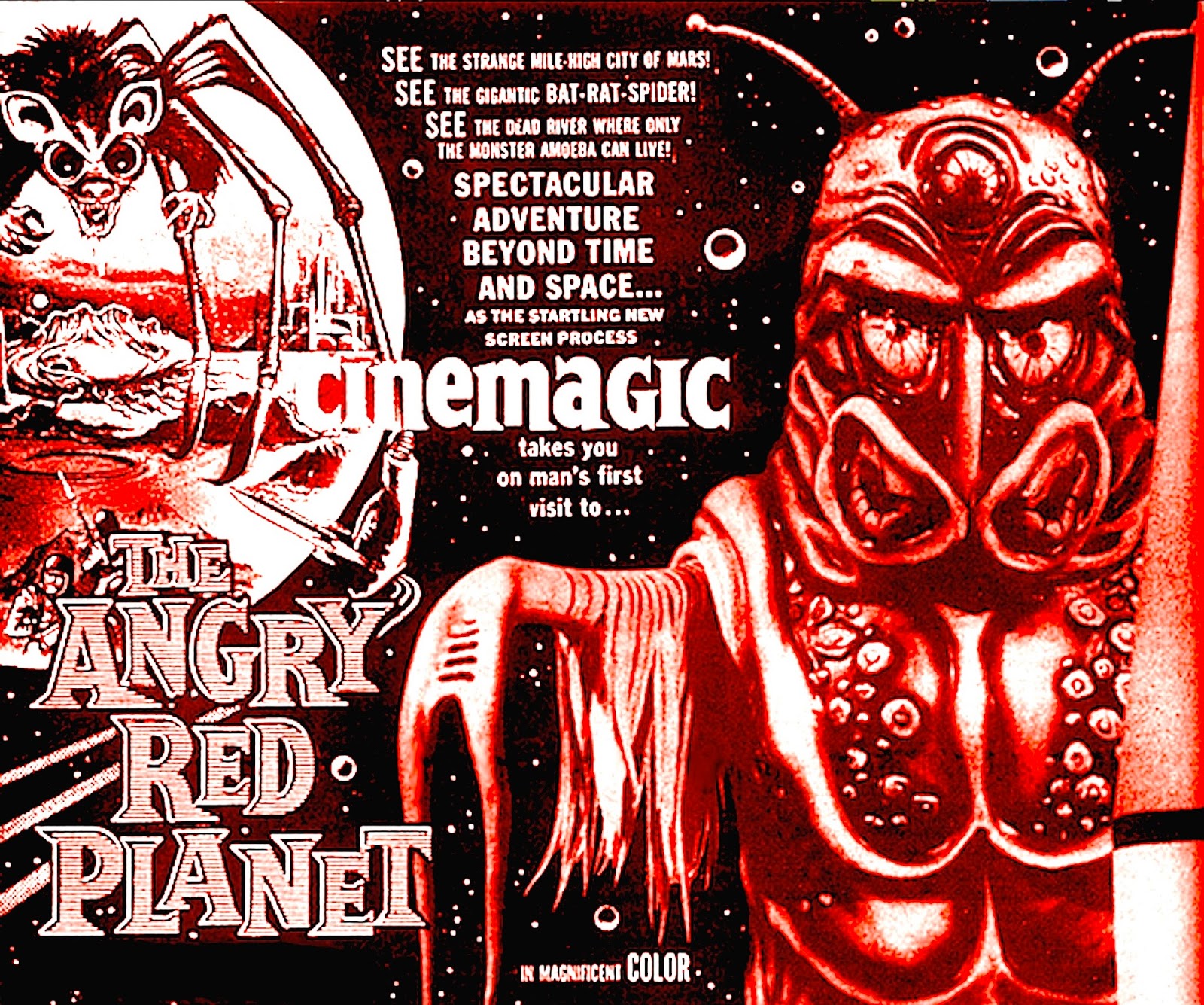
10. In my book Mars in the Movies, there is a discussion of The Angry Red Planet (1959) and of the Cinemagic process in which much of the picture was filmed. Cinemagic was the brainchild of Norman Maurer. In fact, the results that appeared in the finished movie on the big screen were not what Maurer had intended. In order to realize his vision, he would have needed to work with film lab technicians through trial and error to correct the images. But the production ran out of time and money, and there was no choice but to release the picture in a compromised state. Later in The Three Stooges in Orbit (1962), which he produced, Maurer was able to successfully show, albeit in a very abbreviated version and in black and white, what he had hoped to achieve with Cinemagic. The clear potential is very interesting. The actors in both movies needed to be filmed in high-contrast, so their costumes and makeup could only be black and white. Here we see the Stooges on set in makeup (left) and the final processed Cinemagic image (right) with a cartoon effect. The sequence in the film was only a couple of minutes long and was shown on a TV set. Nonetheless, this had been the original concept for The Angry Red Planet, though within a bright red setting.


In a way, The Angry Red Planet
and The Three Stooges in Orbit
are kissing cousins, sharing
efforts to bring Cinemagic
to life.


11. When director Byron Haskin gathered his team in Death Valley to begin filming Robinson Crusoe on Mars (1964), he made a supremely clever discovery. The pure brilliant blue skies visible over the mountains and desert were a perfect natural blue screen, and he used this fortuitous discovery to insert the film’s red skies, one of the high points of the movie. Here is a scene around dusk; we see the fading red sky and the growing night, not to mention three alien craft borrowed incongruously from Haskin’s earlier film The War of the Worlds (1953). 


Formal Notice: All images, quotations, and video/audio clips used in this blog and in its individual posts are used either with permissions from the copyright holders or through exercise of the doctrine of Fair Use as described in U.S. copyright law, or are in the public domain. If any true copyright holder (whether person[s] or organization) wishes an image or quotation or clip to be removed from this blog and/or its individual posts, please send a note with a clear request and explanation to eely84232@mypacks.net and your request will be gladly complied with as quickly as practical.

Sunday, April 16, 2017

KPCC 83.9 AirTalk’s Friday FilmWeek, NPR LA


Here is the link to the broadcast!
https://www.scpr.org/programs/filmweek/2017/04/14/56194/mars-in-the-movies-a-history-on-how-the-planet-has/

AirTalk's Web Page
At my wife’s recommendation, my publisher McFarland’s publicist had sent Mars in the Movies: A History to Larry Mantle, the host of National Public Radio (Los Angeles)’s—KPCC Air Talk, including the Friday segment “Film Week”.  We listen to Larry in the car whenever the timing of our driving corresponds with his show.

Well, what do you know? Last Tuesday I received an e-mail from Jacklyn Kim, a news clerk at KPCC, with the subject line  “INTERVIEW REQUEST - KPCC Radio”


Jacklyn Kim
That got my attention!

Jacklyn invited me to be on the show, and when I accepted, she asked me to share three or four iconic moments from Mars movies that are available on YouTube. I sent her  five (I include them at the end of this article):

Anyway, Jacklyn proved to be very nice, guiding me through the process. It was only a fifteen minute segment, but I’d never been interviewed before, so the guidance proved to be just what I needed to stay calm.

Fast forward to Friday, we drove the 70 miles or so to the NPR building in Pasadena (where you’ll also find the Rose Bowl, the Rose Parade, and NASA’s Jet Propulsion Laboratory, where I used to work for many years!).

During a two-minute break in the show, quickly I found myself in a tiny room (a sound booth I guess you’d call it) with headsets on and a microphone about an inch from my face sitting opposite Larry Mantle. He was a gentleman, greeting me, and quickly explained the flow of the segment. 

Larry Mantle

Justin Chang
Peter Rainer
To my immediate left was Justin Chang, renowned Los Angeles Times film critic, and to his left was Peter Rainer, the equally renowned Christian Science Monitor film critic.

I could hardly catch my breath when the show began with a mashup of Danny Elfman’s theme for Tim Burton’s Mars Attacks! and the trailer of The Angry Red Planet (1959) announcing the miracle of CINEMAGIC. A few seconds later, Larry explains what it was we’d just heard; then he introduces me and the book.


Timewise, all four of us spoke about equally. Plus call-ins were encouraged and several people named their favorite Mars movies. One person shouted out an I Love Lucy episode that was totally new to me. I would have loved to have talked more about the book. Still it was a great experience.
 
Towards the end of the broadcast, they played the iconic Gene Berry clip from The War of the Worlds, and shortly after, the program ended with Marvin the Martian.

Gene Berry telling Les Tremayne, “Take my word for it, 
General!...You better let Washington know!"


Here is the link to the full broadcast so you can listen to your heart’s content!:


I hope you liked this digression from the normal feast of Mars film miscellania!

ICONIC CLIPS THAT I SENT TO THE RADIO STATION

They didn’t use Jeff Wayne’s Musical Version of the War of the Worlds probably because Richard Burton’s narration would have been too long, and besides, it isn’t technically a movie!


The War of the Worlds (1953) (iconic sequence that includes Gene Berry emphatically ordering “Take my word for it, Genera!”
2:38

Jeff Wayne’s Musical Version of the War of the Worlds (Richard Burton’s iconic narration followed by swelling band and orchestra)
 3:34 - 4:40

Haredevil Hare (Marvin the Martian)
 It’s a great 30 snippet from the original cartoon.

The Angry Red Planet (Trailer)
References to “Cinemagic”

Mars Attacks! (Title Sequence, see my Mars Attacks! post)
Full of amazing music with choir and theremin (see pp. 185-186 in my book)

P.S.: The whole thing moved so fast that it was only afterward that I realized that I had quoted Peter Rainer twice in my book, but I didn't make that connection during the 15 minutes when were all together. His quote about THE MARTIAN perfectly encapsulates my own view: "Given the enormousness of its subject, there is a radical lack of awe in the movie." Too bad I didn’t put 2 + 2 together earlier.  <<<SIGH>>>


Formal Notice: All images, quotations, and video/audio clips used in this blog and in its individual posts are used either with permissions from the copyright holders or through exercise of the doctrine of Fair Use as described in U.S. copyright law, or are in the public domain. If any true copyright holder (whether person[s] or organization) wishes an image or quotation or clip to be removed from this blog and/or its individual posts, please send a note with a clear request and explanation to eely84232@mypacks.net and your request will be gladly complied with as quickly as practical.